
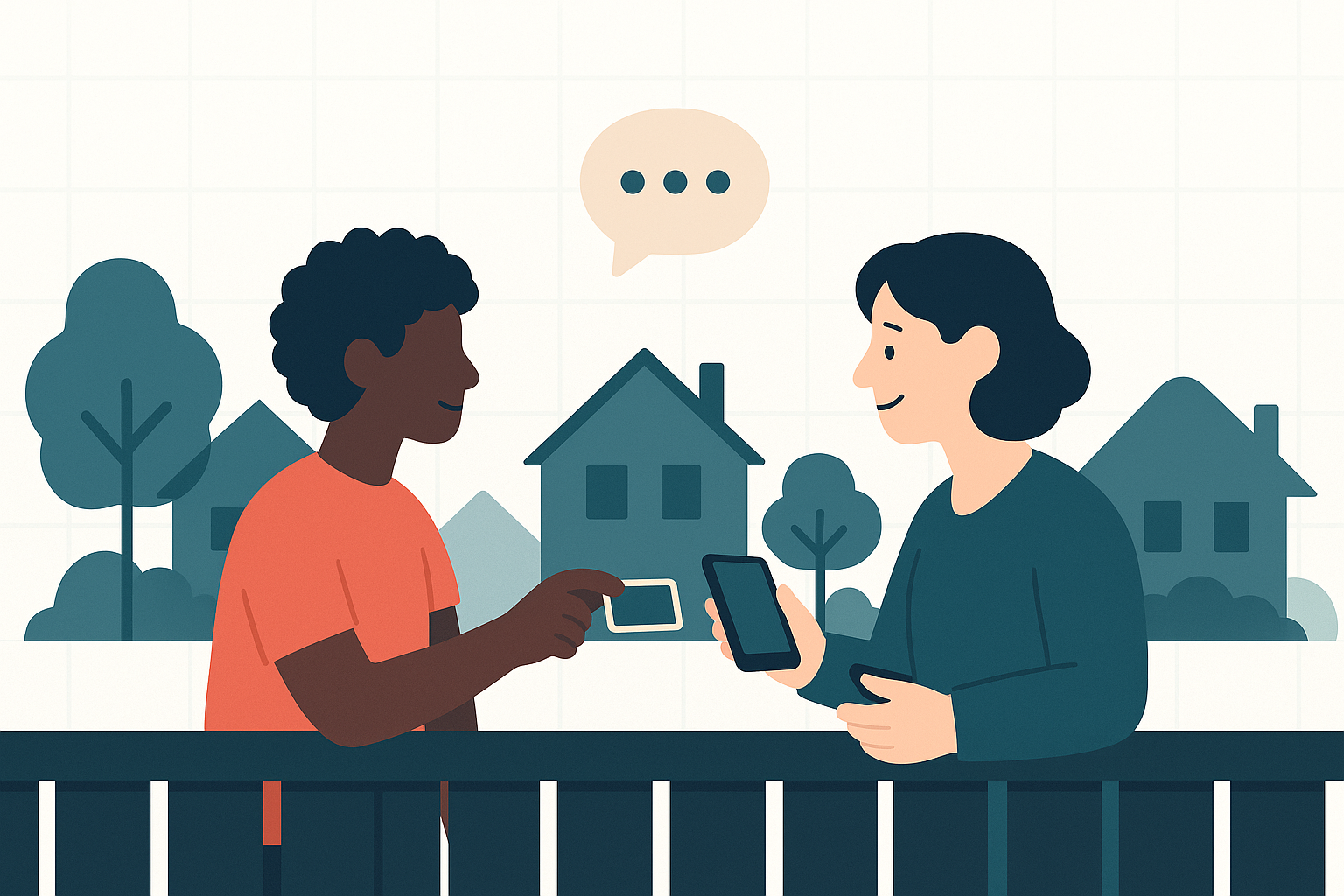
Self-reliant households. Connected neighbourhoods. That’s real resilience.
The truth about “being resilient”
When officials say “be resilient,” many of us hear “cope harder, alone.” That’s not how communities get through a storm. During the Auckland Anniversary floods, the households that fared best weren’t just the ones with kits gathering dust; they were the streets where neighbours already had each other’s numbers, knew who needed checking on, and could coordinate without waiting for official word. The difference between chaos and capability? Connection—practical, local, and ready to act.
Getting the terms straight
Let’s clear something up. Self-reliance and resilience aren’t the same thing, though they work brilliantly together.
- Self-reliance = operational autonomy at the household level—water, food, medications, communication back-ups, and power workarounds sorted.
- Resilience = the ability to absorb a hit, adapt, and re-engage—amplified by connection (people, places, and plans).
They’re orthogonal: you can be high on one and low on the other. The sweet spot is high on both.
Why “I’m sorted” or “I can’t afford it” misses the point
Communities that teach “resilience” but skip the “connection” axis just push people into lone-wolf strain. You might survive, but you’ll exhaust yourself doing it. Connected self-reliance means households are ready AND streets work together—that’s where Papakura needs to be.
Here’s the simple framework that guides our approach:
| Alone | Connected | |
|---|---|---|
| Not prepared | Fragile | Ad-hoc scrambling |
| Prepared | Lone-wolf strain | Connected self-reliance ✓ |
We hear it all the time: “We’ve got our supplies sorted, we’re good if there’s a flood.” That’s brilliant—but what about your neighbours? When the elderly couple next door runs out of medication, or the solo mum across the road needs help clearing storm debris, your preparedness only goes so far. Resilience doesn’t stop at your property line.
Then there’s the flip side: “I don’t have money for all that gear.” Fair enough—but here’s the thing. Not preparing means you’ll need to lean on others when things go sideways, pulling resources from people who might barely have enough themselves. The good news? Connection costs nothing. Knowing your neighbours is free. Sharing phone numbers is free. And when five households coordinate, suddenly everyone doesn’t need everything—you share the load.
Bottom line: Papakura needs both. Store your water AND swap numbers with your street. It’s not either-or, it’s both-and.
The first 72 hours: reality check
In a major event, emergency services triage life-threatening calls first. Roads can be blocked. Power and comms may be down. That’s not neglect—it’s how large-scale response works. NEMA and Auckland Emergency Management advise planning for at least three days of household supplies—including around 9 litres (3 litres per person per day) of water—because help may not reach you immediately.
What we control: household readiness and fast street-level coordination. We’re not replacing the official response—we’re holding the fort intelligently until resources arrive.
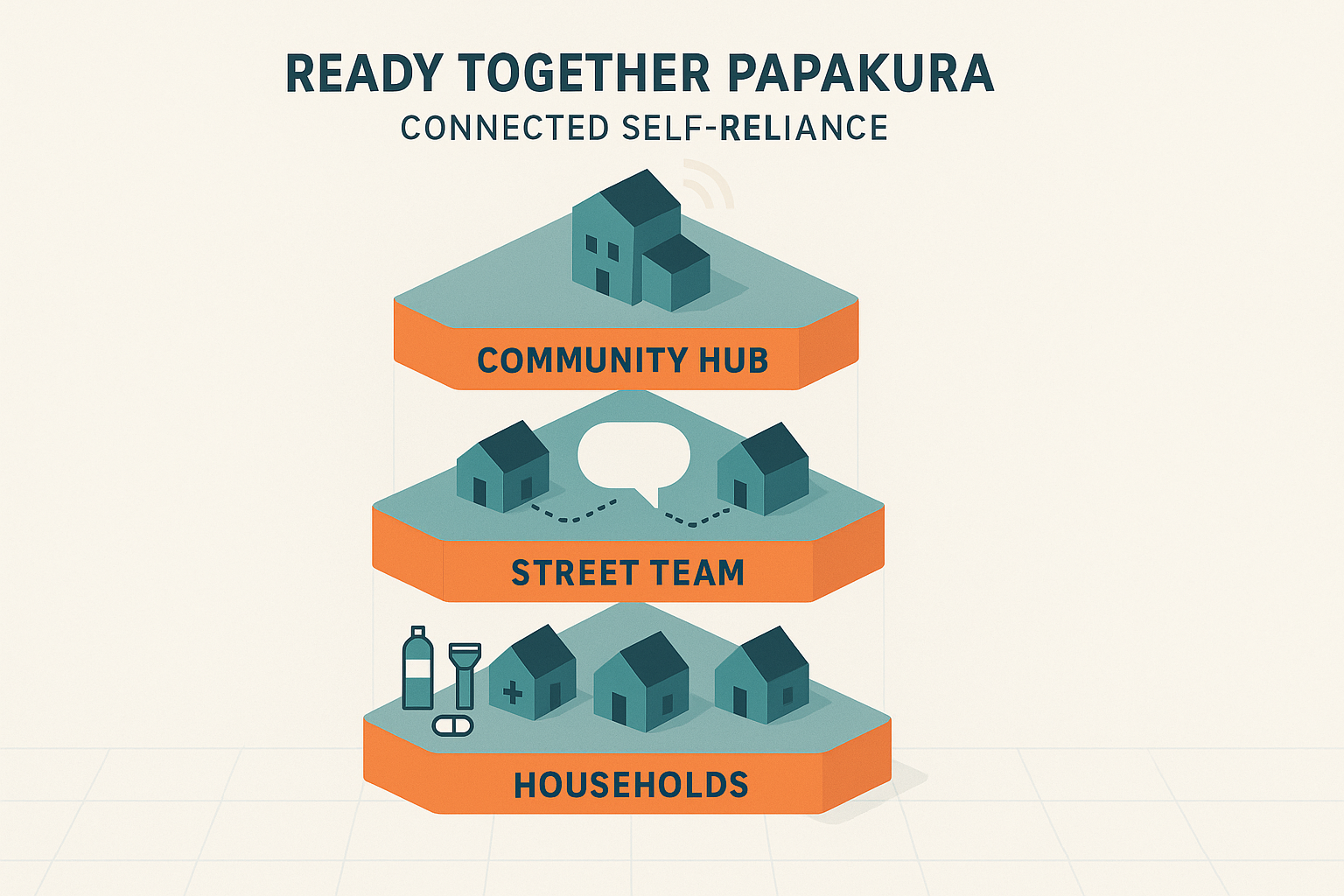
The Papakura model: three layers that stack
1) Household (foundation)
Your 72-hour base: water (aim for ~9L per person), long-life food that doesn’t need cooking, medications listed and stocked, emergency contacts written down, and a basic power workaround for essentials.
This week’s minimum moves: top up water; update meds list; write contacts on paper; test one power backup.
One habit: a 10-minute “storm watch” checklist before heavy rain.
2) Street Team (your network)
Three to ten nearby households linked in a group chat with a couple of light roles: Comms (keeps info flowing), Welfare (checks on vulnerable neighbours), Practical (tools, know-how).
Minimum moves: knock on doors; swap numbers; create a “[Your Street] Check-In” chat; pick a trigger (e.g., power out 30+ minutes → everyone posts a quick status).
One habit: a 15-minute monthly check-in drill to build muscle memory.
3) Community Hub (coordination point)
A known place with a simple framework for information exchange and wider coordination—could be a school, marae, church, or community centre. Everyone knows where it is and when it activates. In Auckland, Civil Defence Centres are opened where needed, and Community Emergency Hubs provide community-led coordination resources.
Minimum moves: identify your nearest Civil Defence Centres; share the location and activation triggers with your Street Team; note two volunteer contacts who can help if the hub opens.
The Youth Factor

Young people already practise collective resilience online—fast check-ins, shared humour, micro-actions. Bring that same energy to your street: quick doorway checks, moving bins for older neighbours, shout-outs to whoever grabbed extra batteries for everyone. “Laugh together, prep together.”
Your 15-minute win this weekend
- Knock on three doors (both sides and across the road).
- Say: “Kia ora—I’m getting our street ready for storm season. Can we swap numbers for emergencies?”
- Create a group chat called “[Your Street] Check-In.”
- Agree one simple rule: “If power/phones go down, we do face-to-face checks at [time].”
Door-knock script (use/adapt):
“Hey, I’m [name] at [house number]. After last year’s floods, a few of us are setting up a simple emergency check-in. Nothing heavy—just a group chat so we can make sure everyone’s OK if something happens. Keen to be in?” [5]
The bottom line
In big events, help is triaged and delayed; the first responders are neighbours. Connected self-reliance—self-reliant households plus connected streets and hubs—is how Papakura stays safe and sane until resources arrive. Start with those three doors this weekend.
Ready to take action?
- Create a Street Team → Ask us about hosting a “Street Meet” in your neighbourhood. Get connected!
- Add to your skills → Check our Events Calendar for the next emergency training sessions
- Prepare a Go-Bag for your household → Grab Bag Basics – Be Ready to Leave Fast
- Get things started on your street → Down load the Street Leader Handbook
Resources
Get Ready (NEMA): Storing water — “Store at least 3 litres per person per day (9 litres for 3 days).
Auckland Emergency Management: Civil Defence Centres (interactive map and overview).


0 Comments